Zero-point shift of Gaia DR2 parallaxes
Measurements of parallaxes of 81 detached eclipsing binary stars in the Milky Way allowed for the determination of the global zero-point shift in the Gaia Data Release 2 (DR2) parallaxes.

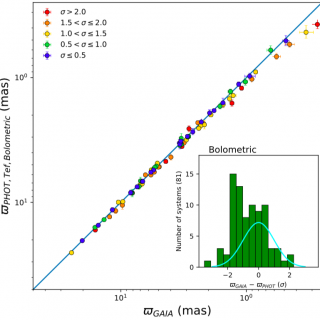
Measurements of parallaxes of 81 detached eclipsing binary stars in the Milky Way allowed for the determination of the global zero-point shift in the Gaia Data Release 2 (DR2) parallaxes.

Applications are invited for one postdoctoral position at the Nicolaus Copernicus Astronomical Center (NCAC), in Warsaw, Poland, in the field of extragalactic distance scale.

We welcome in our group a new PhD student Mikołaj Kałuszyński.

With great sadness we inform that the Araucaria’s member, Zbigniew Kołaczkowski, passed away on September 22, 2018.

Metallicity is a vital parameter that impacts classical Cepheids’ luminosities. In all observed bands, metal-poor Cepheids in the SMC are intrinsically fainter than their more metal-rich counterparts in the LMC and MW.

Based on new observations and improved modeling techniques, we have re-analyzed seven Cepheids in the Large Magellanic Cloud.

Before we start an observing night, twice a year we get to see this gem: a marvelous sunset captured from Observatory Cerro Murphy of the setting Sun, that illuminates four Unit Telescopes of Very...
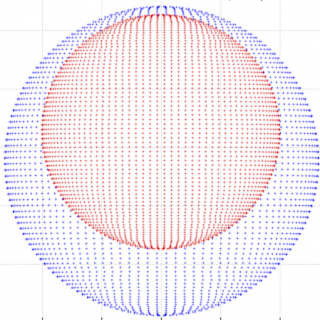
We present analysis of eclipsing binary star LL Aqr which contains a solar twin component.
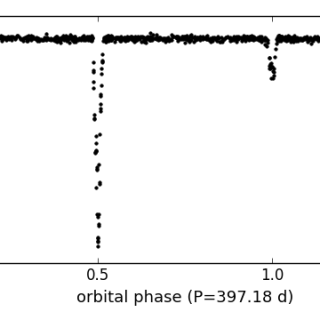
We present the results of a study of the type II Cepheid in the eclipsing binary system OGLE-LMC-T2CEP-098.
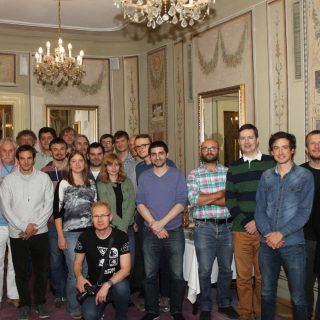
The Araucaria Meeting took place at the end of September 2017 in Crocow, Poland, and was attended by 23 people from 11 scientific institutions in six countries.